Info /
Vincenzo Leonardi
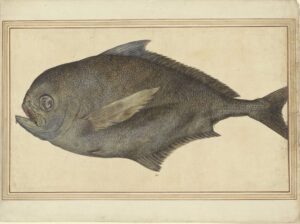
Ray’s Bream, Brama Brama
Watercolour and bodycolour heightened with silver and gold 32.1 x 54.4 cm; Numbered in dark brown ink 375 under fish, laid down, in the George III mounting sheet with wash border
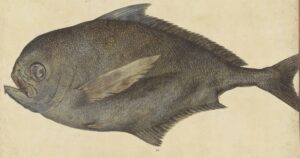
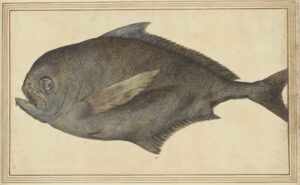
When compared with other illustrations, this Brama Brama stands out for its incredible realism and quality. The scales are beautifully rendered, the fins almost feathery and the eye is shown exactly as it is when a mesopelagic (deep-water) fish is out of water. No detail was missed, including the little protrusions from the lower jaw, believed to be the first documented case of fish parasitism.
The normal habitat of a Ray’s bream, commonly known as the Atlantic pomfret, is the Atlantic, and only rarely are individuals found in the Mediterranean. At the time when this was drawn, therefore, even acquiring the fish would not have been a particularly simple task. Some of the details, such as its bluish hue and the uneven appearance of its belly, would suggest that the fish was either beginning to rot or to dehydrate, and that therefore some time had passed between its death and the artist having the opportunity to reproduce its likeness.
Unfortunately, not much is known about the artist, Vincenzo Leonardi, to whom we owe the present drawing, other than his work with Cassiano dal Pozzo, having even been called his “disegnatore ‘di casa.’” He is, however, considered to be Cassiano’s “finest natural illustrator,” and is the only artist whose name can be attached with certainty to the natural history drawings in Cassiano’s Museo Cartaceo.
The ‘Paper Museum’ was perhaps one of the greatest encyclopaedic projects ever attempted, let alone by a private citizen and its ideator played a key role in the scientific developments of his time. In 1612, Cassiano dal Pozzo moved to Rome and by 1623, thanks to his friendship with Francesco Barberini, now Cardinal Nipote, he came into the orbit of the papacy upon the ascendancy of Urban VIII, Maffeo Barberini. He undertook two trips to France and Spain with the papal legation and, as well as during his various travels around Italy, met and subsequently maintained friendships with some of the leading figures of his day. Cassiano joined the Accademia dei Lincei in 1623, and along with his fellow academicians, helped Galileo to publish his Assayer and the idea that the earth revolves around the sun.
After Cassiano’s death, the ‘Paper Museum’ descended through his family for several generations until the majority was sold to Pope Clement XI, inherited by Cardinal Alessandro Albani and then bought through the Adam brothers by George III. It remained in the Royal Library until the beginning of the 20th century, when parts of the natural history volumes, including the present illustration, were separated and sold off on the London art market. An extraordinary provenance for an extraordinary work of art and science.
Gallery