Master of the Judgement of Paris
(Active in Florence, first half of the 15th century)
Info /
Master of the Judgement of Paris
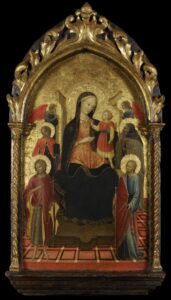
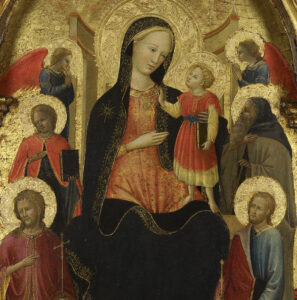
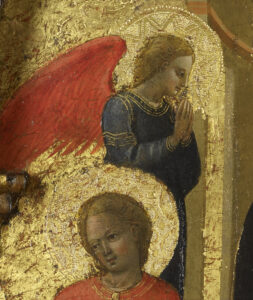
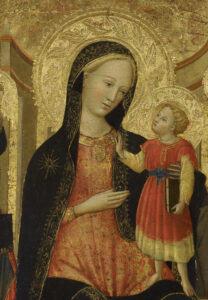
Madonna & Child with Saints and Angels, c. 1425–30
Tempera on panel, 77 x 45 cm (30 1/4 x 17 3/4 in.)
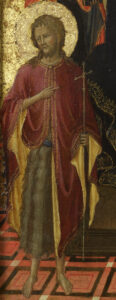
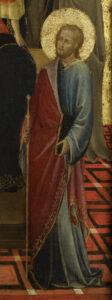
This panel is a small altarpiece designed for private devotion. Such items were part of the standard décor in the homes of wealthy Florentine merchants and bankers in the 15th century. The choice of saints depicted in the altarpiece includes St. John the Baptist, the patron saint of Florence, suggesting that the owner of the altarpiece is likely to have been a resident of that city, while St. James, on the other hand, is linked to the profound and widespread devotion to that saint whose shrine in Santiago de Compostela was one of the most popular destinations for pilgrims at the time. And finally, the cult of St. Anthony Abbot was generally associated with his alleged healing powers, including the healing of animals, and he was thus enormously popular in cities and rural areas alike.
Painted in the Late Gothic style which, in Florence in the first half of the 15th century, was the dominant idiom, it is attributed to the Master of the Judgment of Paris, a painter whose identity is not known to us, but who worked in Florence in the first half of the 15th century. Its inclusion in the artist’s oeuvre is justified by a comparison with paintings known to be by him, first and foremost the tondo depicting the Judgment of Paris (Florence, Museo Nazionale del Bargello) after which he was named, in which we can recognise the same facial features and the typical handing of drapery gathered into long, sharp-edged folds. This artist’s creativity can be seen in the highly original architecture of the throne, in which Renaissance elements such as the sharp edges and polished surfaces of the marble serve as props to flesh out what is, in effect, a thoroughly Late Gothic composition.
In depth studies of this artist’s career have resulted in the identification of a corpus of work which suggest that the painter devoted his energies primarily to producing small devotional altarpieces, bridal chests and birthing trays for the homes of the wealthy Florentine bourgeoisie of his day, while also placing his creativity at the service of such literary themes as the Judgment of Paris and the novels in Giovanni Boccaccio’s Decameron, both in his paintings on panel and in his sophisticated illustrations for manuscripts.
Gallery