Selected Inventory
Master of the Wildenstein Solomon
(active in Lombardy, late 15th - early 16th century)
Info /
Master of the Wildenstein Solomon
Christ in Judgment Surrounded by Saints
Re-sized illuminated initial, tempera and gold on parchment, 144 x 141 mm
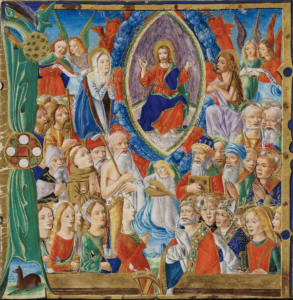
This previously unpublished illuminated initial, dated to around 1500, shows
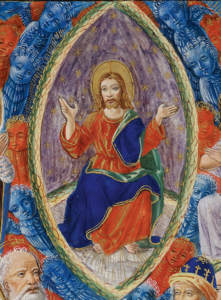
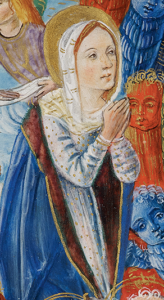
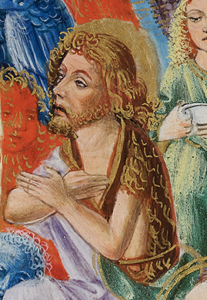
Christ in Judgment in an almond-shape framed by cherubs and seraphs, between the Virgin
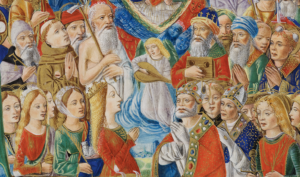
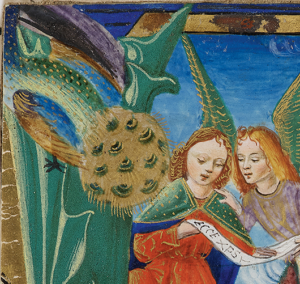
Mary, St John the Baptist and a choir of angels chanting with cartouches reading ‘ECCE XPS’ and ‘GAUDEA(MUS)’. The attributes of the other figures allow us to identify, from top to bottom, Saints Andrew, Peter and Paul, Anthony Abbot, Francis, Adam, David, Stefano, Mary Magdalene, Agnes, Catherine and Peter Martyr.
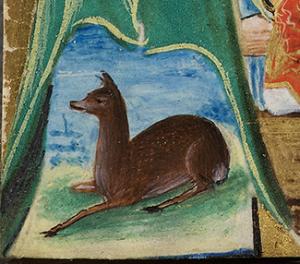
On the left side, two animals typical of Christian iconography are shown. At the top there is a half cut-off peacock, a symbol of the resurrection as early as in paleo-Christian art due to the ancient belief that its tailfeathers regenerated every spring and that its flesh was incorruptible, as evidenced by Saint Augustine – ‘Quis enim nisi Deus creator omnium dedit carni pavonis mortui ne putesceret?’ – and by a sermon by Saint Anthony of Padua – ‘In generali resurrectione […] pavo ille (corpus nostrum) qui mortalitatis penna abjecit, immortalitatis recipient.’ The second animal is a fawn. Based on Psalm 42, ‘Quemadmodum desiderat cervus ad fontes aquarum, ita desiderat anima mea ad te, Deus’ (‘as the deer longs for the source of water, so my soul longs for you, God’), this alludes to the faithful who aspire to communion with God and to the purifying water of baptism. The initial could be an ‘I’, introducing a feast dedicated to Saint Peter, to which the surviving fragments of text on the reverse refer: edificabo ec[clesia mea]/m.
The artist, known as the Master of the Wildenstein Solomon, so-called after an illumination today belonging to the collection of the Musée Marmottan-Monet in Paris, has been tentatively identified as Protasio Crivelli, a Milanese miniaturist active during the decades on either side of the turn of the 16th century.
Gallery