Info /
Orazio Gentileschi
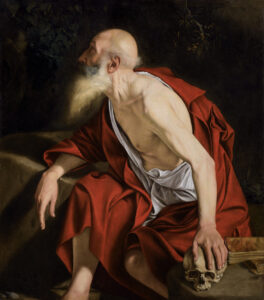
The Penitent St Jerome
Oil on canvas, 127 x 112 cm
Orazio Gentileschi is one of the key protagonists in the Roman artistic scene in the early 17th century. In 1610 we are at a very important cultural crossroads, since Caravaggio had left Rome five years previously but his influence and style was still struggling to assert itself. Orazio, a friend and admirer of Caravaggio, ventures a completely new and personal reading of Caravaggio’s artistic models, often described as a sort of “caravaggismo in chiaro” in which this new style is grafted onto a training based on the examples of late Florentine Mannerism. Orazio is at the pinnacle of his Roman career, enjoying the protection of Pope Paolo V Borghese and his nephew Cardinal Scipione for whom he worked on the Casino delle Muse in the Palazzo di Montecavallo.
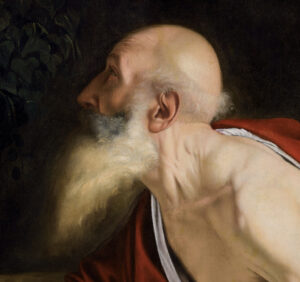
At this same time Orazio also paints this first version of St Jerome, possibly one of the last from this period of Gentileschi’s career that is still available on the art market. This painting is well documented since its first publication by Roberto Longhi in 1943 and for this occasion it was been the subject of a new volume edited by Keith Christiansen. This Saint Jerome can be dated with extreme precision thanks to the testimony given by a seventy-two-year-old pilgrim from Palermo, Giovanni Pietro Molli, at the trial for the rape of Orazio’s daughter, Artemisia, in which he recalls how during the Lent of the previous year, he had posed for a long time for Orazio “per ritrare una testa simile a me per certi quadri che lui faceva” – (“to portray a head similar to mine for certain paintings he was doing”) and in particular for “un San Girolamo intiero […] simile a me” – (“a full-length Saint Jerome […] similar to me”). Orazio returns to this theme in a second version in the collection of the Museo Civico d’Arte Antica in Turin in which the landscape is more spacious, in our version the attention is instead entirely concentrated on the powerful central figure of the Saint taken from a very close viewpoint that omits the lower part of the legs, in accordance with a compositional solution common in other paintings of the same period such as the “Sacrifice of Isaac” in the Galleria Nazionale della Liguria or the “David” in the Galleria Spada.
Gallery