Info /
Johann Heinrich Wilhelm Tischbein
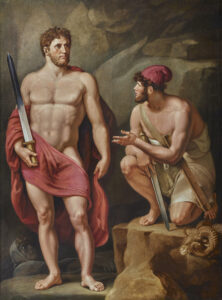
Ajax and Ulysses in Orcus
Oil on canvas, 222 x 165 cm, 1790s - 1813
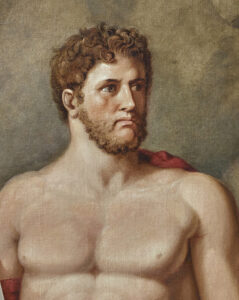
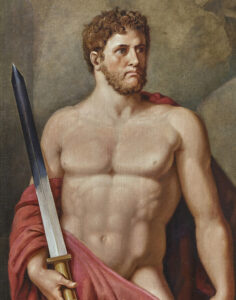
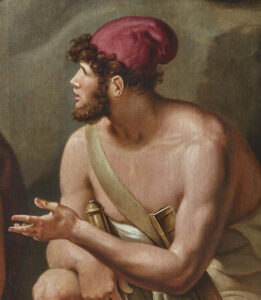
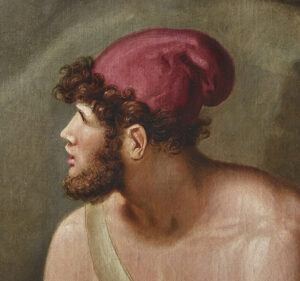
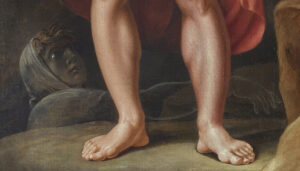
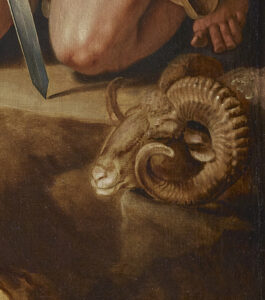
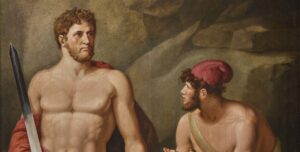
In this painting, Tischbein depicts the Greek heroes Ajax (standing to the left) and Ulysses (crouching to the right) on a mythological and almost larger-than-life scale at the entrance to the Underworld. Ulysses, having made his sacrifice, his sword stained by the black blood of the ram whose head lies beside him, addresses Ajax whose sword is still covered in his own blood following his tragic demise during the Trojan War. Ajax’s stoic position and steely gaze, directed over Ulysses’ head and never at him, reflect the anger felt towards his former comrade-in-arms, fervent even in death.
Tischbein started this painting in the 1790s when he was still in Italy and he took it, along with many other examples of his own work and as much of his extensive collection of Old Masters that he could take, when he was forced to flee Naples in 1799 during the French occupation. The artist dedicated much time to Homeric themes, publishing his “Homer nach Antiken gezeichnet” (Homer Drawn from the Antique) in 1801 and executing a series of large-scale paintings for the Duke of Oldenberg, for whom he served as court painter and inspector of collections from 1808. When he eventually finished Ajax and Ulysses, Napoleon’s occupation of the Duchy forced the Duke and his family to flee and so the painting did not join the others in the Duke’s palace in Eutin, but remained unclaimed in Tischbein’s studio, until in 1813 he sold it in order to support his wife and six young children, to a Belgian baron, in whose residence it has remained to this day.
Gallery